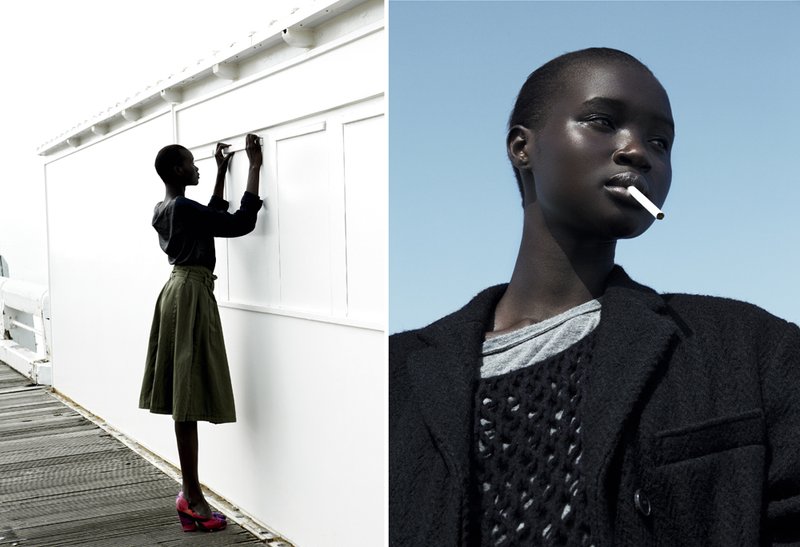
South Sudanese model Ataui Deng moved to the United States in 2004. Four years later her modeling career started when she signed a contract with Trump Models. Since then Ataui has walked the runway for Zac Posen, Lacoste, Christian Dior and John Galliano. She also appeared in magazines such as Teen Vogue, V Magazine and appeared on the cover of French Revue de Mode and shot campaigns for Kenzo and Benetton, among others. I recently caught up with her.
Tell us how you were discovered.
I went to a modeling expo with my family in Dallas. It was there I met Duane from Trump and he signed me.
What challenges have you faced, if any, as a model of color?
I haven’t faced any challenges so far. As a model of color designers have a tendency to put me in bright colors which I don’t mind.
What have you discovered about yourself through modeling?
That I was born to do this.
What are your goals for the future?
I’d like to keep moving forward and one day try designing shoes.
What would people be surprised to learn about you?
I think they’d be surprised to learn that I’m a free spirit.
From humble beginnings in Calgary, to the cover of Italian Vogue, Lisa Cant epitomized the doe-eyed ingénue of the early noughties. With campaigns for Chanel, Akris, Juicy Couture and Daks under her belt, Lisa stepped back from the limelight to attend university. Now a mother, Lisa balances her new role with the new challenges that brings. I caught up with Lisa to find out what she’s up to these days.
What went through your mind when you were approached in Ikea to try modeling?
I was pretty surprised – I’d never thought of modeling before that moment. I never imagined that it would take me this far.
After six years of modeling successfully you decided to enroll at Columbia University. What was the trigger for this decision and how did you maintain balance?
I was just looking to do something different. I wanted a challenge and thought that university would be incredibly enlightening – which it was. I definitely had to cut back on traveling and working. I probably could have done a better job of finding time for work, but I became very involved in my studies and rarely wanted to miss classes, so I turned down a lot of potential jobs. I felt like it was the right thing for me at the time as I wanted to do my best in university.
You are involved with The Model Alliance. What was the impetus for making this decision?
Sara Ziff, the founder, approached me and asked if I would write an essay about going back to school. We were both in Columbia at the time and she wanted a model’s perspective about the challenges of balancing modeling and studies.
What have you discovered about yourself through modeling?
I learned that I can be patient. Modeling takes a lot of patience, you are primped all day at work, sometimes longer than you are even shooting.
What are your goals for the future?
I would like to keep an open mind for the future. I don’t have any concrete plans and no specific goals at the moment, which I enjoy.
What would people be surprised to learn about you?
That I had a baby last year; little Charlie is the center of my life.
What advice would you give to someone about to embark on a modeling career?
To be persistent. I was rejected by a lot of agencies before I began working. If someone really wants it they need to try smaller markets and just keep working at it.
What are you most grateful for?
The love of my family.
What was the last book you read?
Beautiful Ruinsby Jess Walters. Makes me want to go to Italy in the 1960s.
What last made you cry?
I’m not much of a crier – definitely not in movies.
Favorite board or card game?
Scattergories
Gamble or invest?
A bit of both.
List three things you are grateful for right now.
The love of my family, the opportunity to spend most days with my son and my health.
At just 19-years-old, Jason Kanner was working at a nightclub in South Beach when he met the director of Florida-based modeling agency Irene Marie, best known for discovering Niki Taylor. Recognizing his eye for talent, Jason was offered a position as junior agent in their Miami office. From there, Jason joined Boss Models, where he worked with top talent such as Amber Valletta, Angie Harmon, Marcus Schenkenberg and Joel West, and procured contracts with luxury brands such as Calvin Klein, Chanel and Ralph Lauren. Kanner then made his way to Major Model Management where he became the director of the Men’s Division. After nine years at Major, Jason decided to transfer his passion and vast industry knowledge into an agency of his own, Soul Artist Management.
Tell us about the transition from agent to agency owner.
The transition has been quite subtle. I’ve been a director of several agencies for over 20 years. Other than signing the checks and worrying about insurance for my employees, it’s really not much different as I’ve always carried a large amount of responsibility.
Why have you made reviving the male supermodel the focus of your career?
It’s not my primary focus, but certainly one I take seriously. Models have played second fiddle to celebrities for quite some time now and I believe that the public has always enjoyed seeing models on covers, so why not recapture that and bring it back. Models are both exciting and inspiring to people.
Actors have dominated magazine covers and campaigns for years. Do you think there is the same level of interest in models as there was a decade ago?
Up until recently that would be correct. Of late, Harper’s Bazaar and Details magazine have featured models on their covers for important March & September issues. The sales of those issues have been equal to or exceeded their celebrity covers. I believe we are on the cusp of something here that has been proven by the increase in sales and circulation on the newsstands.
Models such as Mark Vanderloo and Markus Schenkenberg epitomized the male model aesthetic of the nineties. By the mid noughties, Hedi Slimane had ushered in a more waifish aesthetic for men. What do you see as the next evolution in male models?
Hedi was really more turn of the century and it was more a Kate Moss/Calvin Klein/Mike Campbell/Christian William /Steven Meisel moment that brought in the waif and grunge moment of the nineties in my opinion. I think the new evolution is going back to the classic, good-looking, Hollywood style; masculine and beautiful.
What do you think makes a model a supermodel?
Industry-wise it would be demand from designers and the advertising agencies to hire a model. I believe to be a Supermodel you must be a chameleon, a muse to designers and photographers. You must have energy, personality and a strong connection with the camera. Models are the silent movie stars of a modern time.
How is managing a model’s career different today than a decade ago?
With social media there is a different level of marketing that takes place and models are savvier today than before. They, the models, are well versed in the business and are a large part of the conversation that transpires in building their brand.
Do you think male models can have the same longevity as their predecessors?
Absolutely! Actually, they can have longer careers than females. Just look at the careers of Markus Schenkenberg and Tyson Beckford. Those are careers that have spanned 20 years. Having proper management has aided this of course.
Do you think male models have the same allure as their female counterparts?
That’s a subjective question. With photographers such as Giampaolo Sgura, Mariano Vivanco, Bruno Staub, Richard Phibbs, Arnaldo Anaya-Lucca, Alasdair McLellan and Matthew Brookes taking beautiful and iconic images of men that last the test of time, we are seeing men’s editorial flourish. The editorial itself is lifted and on par with what the girls are shooting
What does Soul Artist Management offer that’s different to other agencies? What advice do you have for young guys starting off in the business?
We are a true throw-back boutique agency. Despite our newness to the marketplace, the agents on our table have over 20 years of expert management under their belts and work with passion. We offer specific, tailor-made management strategies and have fewer clients compared to the larger, mega-agencies of the past. Our work speaks for itself.
What advice do you have for young guys starting off in the business?
I would advise any new model to finish their education. Educate yourself about the industry at the same time, the brands, the photographers and other models. Keep your ego in check but also know that you have a voice. A career is a true collaboration between all artists involved with the model as muse Bring your voice. Let it be heard.
With corn-fed good looks, Cory Bond has graced billboards for Dolce & Gabbana and Michael Kors as well as starring with his model wife, Bekah Jenkins, in the new Banana Republic campaign. When he’s not smoldering in front of the camera, Cory can be found back home in Tennessee decompressing from the hectic life of New York.
Tell us about how you were discovered.
ProScout, a model and talent scouting company, came to Nashville. I was scouted at the event and landed an agency.
How do you feel about the renaissance in using models with the archetypal Greek god physique?
Well, I think the fashion industry is trendy. What’s hot today may not be tomorrow. I like my classic look; it never goes out of fashion. I’m in love with old Hollywood.
How do you handle the scrutiny and rejection that comes with modeling?
In the world of modeling you are constantly being judged and sized up. If you can’t handle that then you won’t like being a model. I handle it by staying in shape and taking good care of myself. If I hear no from an audition then I can rest assured knowing that I did my part and I wasn’t what the client had in mind for the shoot. Somethings just aren’t meant to be. I don’t lose any sleep over it.
How do you handle the isolation that comes with modeling?
I learned to live alone. I can go to a great restaurant or a movie all by myself, but I like to eat with others from the job and get to know everyone. Also, when I’m in a cool city I like to get out and see the town a bit.
Tell us about your relationship with social media.
I use social media to show people what I see on trips and what I like. Before social media I’d have to take photos and develop the film then show people and try to describe what it was like. Now, I can show you a video or a photo of exactly what I’m looking at in the moment.
What are some of the misconceptions you face as a male model?
That male models are dumb or that it’s not a “real job”. Thanks Zoolander!
If you weren’t modeling, what would you be doing?
Well, I would most likely be working as a photographer or an entertainer of some kind.
What have you discovered about yourself through modeling?
That I love to travel. I don’t think I’ve been anywhere in the world that I didn’t find something that I loved or that I was inspired by.
What are your goals and aspirations?
My goal is to continue building my name and brand. I want to continue working in this business and do more TV commercials and acting.
What advice would you give to your younger self about to embark on this journey?
Never forget where you come from and embrace the opportunity that you have been given.
As one of the founding partners of Rag & Bone, Nathan Bogle turns his attention to his new label Jardine. Named after his great-grandfather, Jardine was founded on the principles of exceptional quality and blends style and substance in a harmonious marriage. I spoke with Nathan about his transition from modeling to designing and his hopes for the future.
Your discovery story was more unusual than most. Tell us about the genesis of your modeling career.
I was living on an island in Thailand. I had cut all my hair off when this Parisian cab driver said I should try modeling. She knew a lot of people in the fashion world and thought I could make some dough. I was in full traveler mode so the idea of it didn’t appeal to me at the time. When I returned to the cold bleak reality of England and my previous job as a line chef, getting paid for standing in front of the camera all of a sudden seemed very attractive. After I got paid for one days work of modeling, it was a simple mathematical decision. I then had the opportunity to move to New York in 1998 which I jumped at and rest is history.
As a successful model, what prompted you to branch out and start Rag & Bone?
It was a simple case of not finding clothes I wanted to wear and if I did they were overpriced. I came up with the idea of designing the uniform that I and lots of people were wearing of jeans and T-shirts. Marcus and I spent two years learning the trade, teaching ourselves all areas of the business and then launched it in 2004. Having all the contacts in the fashion world really helped but I knew I had to deliver them a product that was excellent and stood for something before I could ask for favors and support.
How did your background in studying permaculture influence and impact you?
I love permaculture! I think it’s the way of the future, though not that commonly known about. I started getting into it in 1994 then studied it in Australia, the birthplace of this form of sustainable living system design. It impacted me on so many levels, but living in New York City those levels are sometimes dampened. I intend to implement all that I learned and more once I get this new brand off the ground. The bigger picture will involve permaculture but it has not impacted my fashion or design in any way apart from compounding the guilt I have for all the transportation and pollution that the textile and fashion industry contributes to.
How did your experience with Rag & Bone influence your new venture Jardine?
I knew what to expect in terms of what it takes to start and build a brand. It is even harder now, because there is so much competition and less capital to splurge on new brands. I learned what it takes to actually manufacture something from sketch to store, and the amount of energy and focus that requires. Ultimately, it all boils down to taste and if ones taste is on point and has the balance of art and commerce right, there’s a chance you might make it. Product is always number one; my philosophy is there is enough average out there, there’s only room for excellence.
What were the core principles you built Jardine on?
Exceptional product quality, no-nonsense brand communication and timeless classic styling so the clothes can be worn for years.
Why was it important for you to produce most of the product in the United States?
Predominantly it is to do with our scale and manageability. It’s obviously a lot easier for me to jump on a train than a plane and be very hands on. At the beginning this is vital. I also think the quality in New York is close, if not the same, as Italy. There are some very skilled sewers in the garment district who simply need direction in order to hone the level of finishing we require.
What were some of the challenges you faced when launching your brand?
Finding the right people to manufacture, sell and promote it. There are lots of people doing all of these things, but there are very few people doing it really well. It’s the same with everything. Getting a brand to market and connecting with the right retailers takes time and money. Building a brand takes time and money so these two elements are always challenging.
We live in an age where most of our life is spent online. How has social media impacted how you do business?
When I started Rag & Bone there was no social media, which is odd to say, having only been 10 years ago. Much like the brand itself, I think social media takes time to build, unless you have the budget and time to be on it all daily, which I don’t. It’s impacted me by adding more work to the table, however it’s a very powerful tool to deliver a very focused brand message. I don’t have a lot of time to spend on the social side but I try to stay active as much as possible.
What inspires and influences you?
Art, music, street life in NYC, film, architecture and food.
How would you like to see Jardine evolve?
I’d like to build my customer base in the US and then begin to branch out internationally. I think for Fall ’14 this will happen. Women are already wearing the mens clothes so there will be a natural evolution into womenswear. Thereafter, who knows; shoes, bags, fragrance, brick and mortar stores, world domination, just give me 10 years.

 THE CULTURAL OMNIVORE