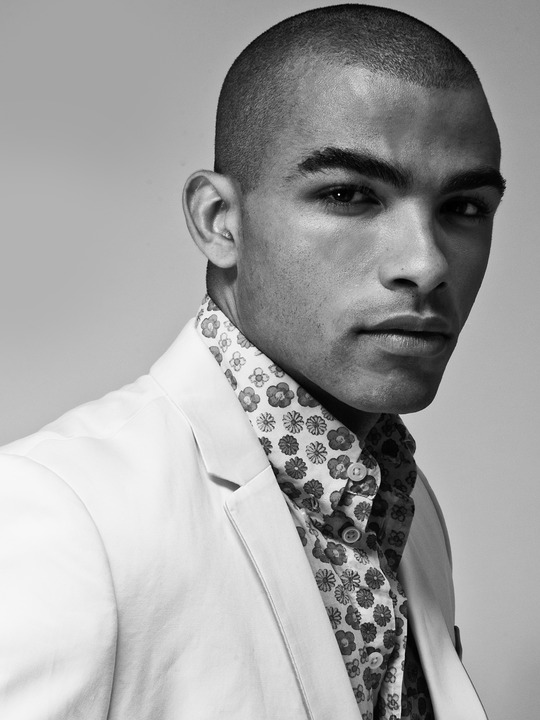
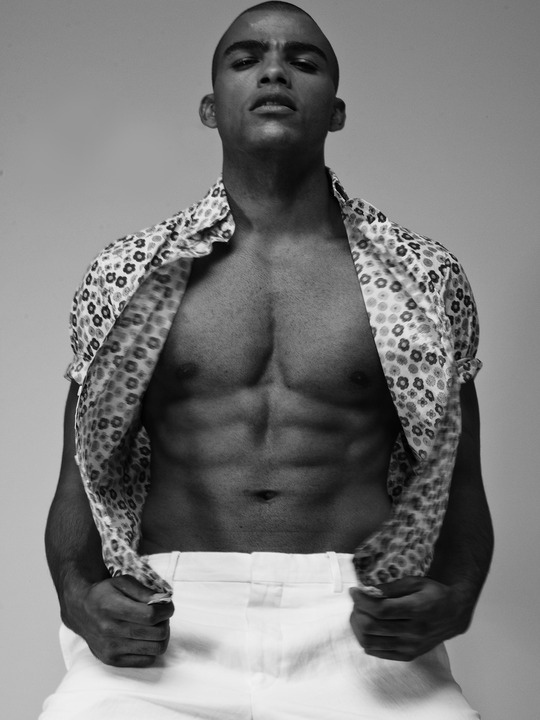
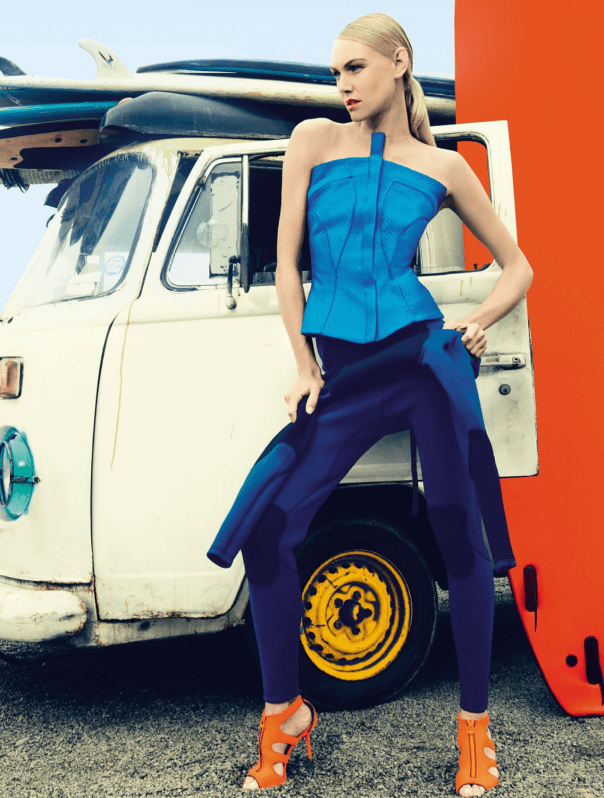
Toby Sandeman is a former UK Athletics national champion turned model. He won two gold medals at the European Athletics U23 Championships and has modelled for Calvin Klein, Ralph Lauren and worked with Naomi Campbell. I caught up with Toby to talk about his career and plans for the future.
What parallels can you draw between modeling and competitive athletics?
The biggest parallel would be the need to always be ready while at the same time being patient. In the modeling world three weeks may pass and you haven’t booked one gig so naturally binge eating pizza and partying every night seems like a good idea. Suddenly you get a call, “Toby, amazing news. Tomorrow you’re shooting with Naomi Campbell for Vogue…naked”. All you can manage is a fake yay with a mouth full of pizza. Luckily, I’ve always stayed on top of my game – or at least haven’t been caught out yet.
I understand you were reluctant to model initially. Why did you have a change of heart?
In the summer of 2005 I saw two of the people I hung around with get 19 years in prison. Another friend was murdered and I was betrayed by two friends. I needed a change in my life – a big change. Modeling was a 180 degree turn from the life I had been living, so I took it.
What challenges have you faced as a model?
I’m a man who likes to put in hard work and contribute to my own success. The challenge modeling sets is that the outcome isn’t always in your hands. You’re born with a certain look and it’s either in fashion or not. There isn’t much you can do except not giving in to binge eating pizza.
What plans do you have for the future?
I just finished the production of my second film, Conversations of Ed-Dick-Shawn, which I also wrote. It is a 1940’s styled film noir piece about addiction. It explores what goes on in the mind of an addict that can draw a man like Phillip Seymour Hoffman back into addiction after 23 years of being clean. We will enter it at Sundance, Tribeca and the Cannes Film Festival which is very exciting.
What does success mean to you?
Professionally success for me is fine-tuning my acting craft to the calibre and standard I have set myself. Personally, success is reuniting my family that is currently spread over the globe.
What have some of the highlights of your career been?
Working with artists like Bruce Weber, Greg Lotus and Patrick Demarchelier. There have also been fabulous locations and some great brands. Working with an artist who is so passionate about their work always takes the top prize for me.
If you weren’t modeling what would you be doing?
Acting, as that is where my passion currently lies.
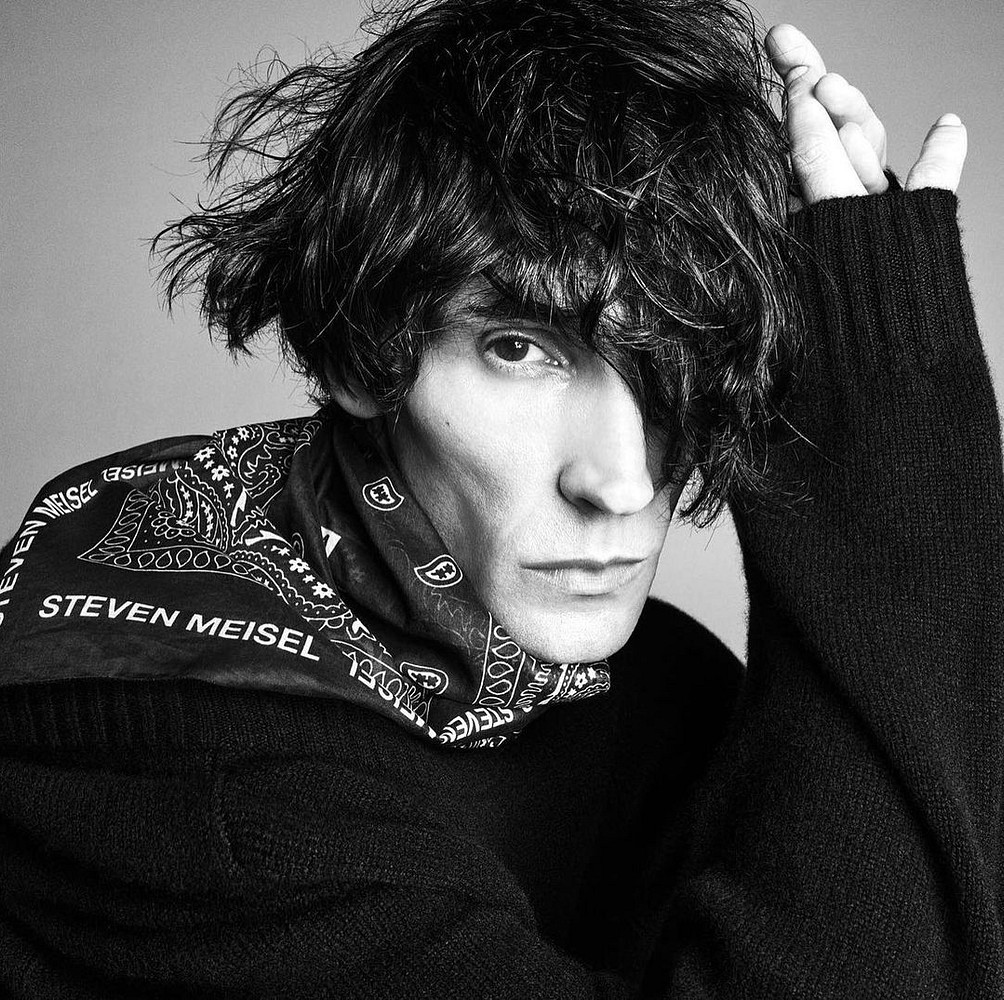
Scott Barnhill was part of the group of American models that dominated the runways in the nineties along with Mike Campbell, Jason Fedele and Jason Shaw. He has fronted campaigns for Versace, Yves Saint Laurent, Dolce & Gabbana, Calvin Klein, Tommy Hilfiger, Valentino and Gucci in addition to appearing on the cover of Italian Vogue. I called Scott to find out what he’s up to these days and to reflect on his 20 years in the business.
Let’s talk about how you were discovered.
I was 17 working in construction and living in Florida. I went to Pleasure Island for my birthday where my brother got me in with a couple of friends. I was scouted by Cindy Cooper who gave me her number and asked me to call her.
You’re originally from Chicago, correct?
Yeah. One day after I got off work I went home and turned on VH1 and there was a fashion award show. I caught it just when Tyson Beckford was winning Model of the Year. I thought, that doesn’t look that hard, I’ll give it a try. I sent Cindy some basic 35mm photos and she set up a test shoot. I went down to Miami to shoot then I drove back to where I lived and they made contact sheets. Cindy set up appointments for me to go back down.
I went to Page Parkes Model Agency with that contact sheet and met Rob who was on their men’s board. He took me on and then I moved down to Miami. I was still doing construction work and I found a part-time job working in a stockroom. Nothing really happened for me on the modeling side. I did do a couple of editorials for teen magazines. Nothing financially came out of it so after six or seven months I decided to try to get my old job back.
My position was filled so I was just looking for a job. I found one working at a gas station pumping gas at a full-service station. After a few months of doing that I got a call to come down to Miami for a casting for Diesel. I didn’t know much about it and that’s when I met Ellen Von Unwerth. Two days later I got a call saying that I had booked the job. They were going to pay me for my driving time, plus my day rate so I said sure.
Before we started shooting Ellen asked me if I had any other surfer friends. I did and showed her a picture of my buddy. She asked me to go drive back up and get him so I went. I picked up my buddy and did the shoot. It was the first time I was in my underwear on the beach.
Would you say that was the pivotal moment that changed the direction of your career?
Oh yeah. Two weeks later I was in New York. My photo had been sent to all the photo reps. Steven Meisel picked up on me and that was the end.
It’s a theme among models that once Steven gives his seal of approval their careers take off.
Yeah, it went from that to shooting Versace. I went back to Miami to do catalogues for a while. I worked with a lot of German sports catalogues. I would work 12-15 days with them at a time and then it was back to Steven. I went back to Miami and went to a casting at the Raleigh Hotel. It was early and I was in the lobby trying to figure out where to go. I met this guy in the lobby and he wanted to know if I would shoot with him. I didn’t know him so he told me to go to my agents and tell them that Mario Testino wanted to shoot me. My agency called him and that opened up a whole other thing. From there it went to more photographers and non-stop for a few years.
You won the VH1 Model of the Year award. From watching Tyson win to you winning must have been surreal.
Yeah, it was.
What was that like winning the award?
I was never in the public eye before. Models now have training. I had no guidance from a PR stand point. When I won it I didn’t know what my voice would sound like. I was on stage at Madison Square Garden and nobody told me that there would be a five second delay in my voice. It was very off putting.
You were a part of the pre-internet era. You won this award, you were in a high-profile relationship. How do think all of that compares to now in terms of social media and coaching? Did you feel that you had more privacy.
Well it wasn’t just privacy. Even now when I walk down the streets in New York people still recognize me. What I needed was guidance. Now we have Project Runway and other reality shows. The whole profile is completely different. It’s been bogged down creatively. It’s two different businesses now. It feels a lot more contrived. It’s really about selling now as opposed to a creative market.
Do you feel that the industry is more contrived now?
It’s all about money management. I think now it’s like here’s the budget, we need a look book. We don’t need someone to steam the clothes we can retouch the photos. One person has to now do so much. There was a time when I was on set that all of that was done. The picture was taken and it was taken a couple of times. Exactly what was on set was what was shown with maybe a little bit of color correction. The only thing that was really done was the cropping. Now everything is Photoshop and Illustrator. Anybody with a digital camera has the opportunity to become somebody great if they have the right connections.
One of the concentrations at Soul Artist Management is to bring back the male supermodel. How do you feel about that? Is it something that is achievable?
Yeah, I think so. The thing is now it could easily be achieved especially with all the marketing outlets that are available but you also have to have substance to back all of that up. You really can’t create a household name based on gimmicks.
How do you feel about shows like The Face and Project Runway? Do you think that they give an accurate portrayal of the industry?
It can only go so far from that venue. If Steven Meisel or another great photographer is going to shoot the winner from America’s Next Top Model it’s not going to do anything for the photographers to shoot them. It’s not going to help sales of the cover of Italian Vogue or American Vogue or anything like that. I don’t think that a winner of a show is going to change the industry.
What would be your biggest take away from your 20 years in the industry.
Follow your path. Don’t take anything for granted. Stay and follow the endeavors you believe in, not just in the modeling field but life in general. Everyone is so young, they don’t know what they want in life. My life changed when I started modeling. The whole world literally opened up. At 20 I wanted to do music and be famous but it’s not going to happen unless you really want it and are willing to work really hard at it. We make it look easy but there was a road to get there.
How did you deal with the pressures and scrutiny of the industry. Was it difficult for you?
I just went with it. I was easy. I remember being at Pier 59 shooting a campaign. I had my skateboard and we were in a huge studio and I just started skating because there was so much smooth concrete. I just lost myself. There was no pressure for me.
At one point I got a phone call from my agent that heard I was being difficult on a job. I was in Paris staying in a hotel and I had just been in three or four different countries in one week. I was in Paris, Jamaica, Italy, Germany and then back to Paris and I was tired. It made me think, are you serious? The agent was in Miami the whole time just doing his daily routine and I was out here busting my ass traveling around being happy-go-lucky and pretending everything is great. I broke down that night. My nerves were shot. I had nobody there with me, nobody to call, nobody to depend on. At that point everything was emotional.
I had my ups and downs following that. I have nothing bad to say about my 20 years in the industry. Just mad respect for the opportunities. I’m so grateful to have worked with such great creatives that allowed me to feel I was being creative. I was a part of their process. That felt good.
What are you doing now? What are your plans?
I play music and I also have a custom handmade bow tie line I’ll be launching soon. On a day-to-day I custom build and I fabricate. Right now I’m standing in a coffee-house that I built from the ground up for a client of mine. They just got the lease for the space next door so what we’re going to do is convert the place into a brunch, coffee-house and wine bar. The last event job I did was for Absolute Vodka. I built them a tunnel in the shape of their bottle. Before that I did an office build-out for a casting director in New York. We custom-built 13 desks and a conference table and their whole kitchen area. I’m trying to get away from the building which is why I’m launching the bow ties. I’ve had them for two years and now I’m ready to take them into small spaces and shops. I want to play my music and take the modeling jobs as they come. I just did a Haider Ackermann presentation in Paris.
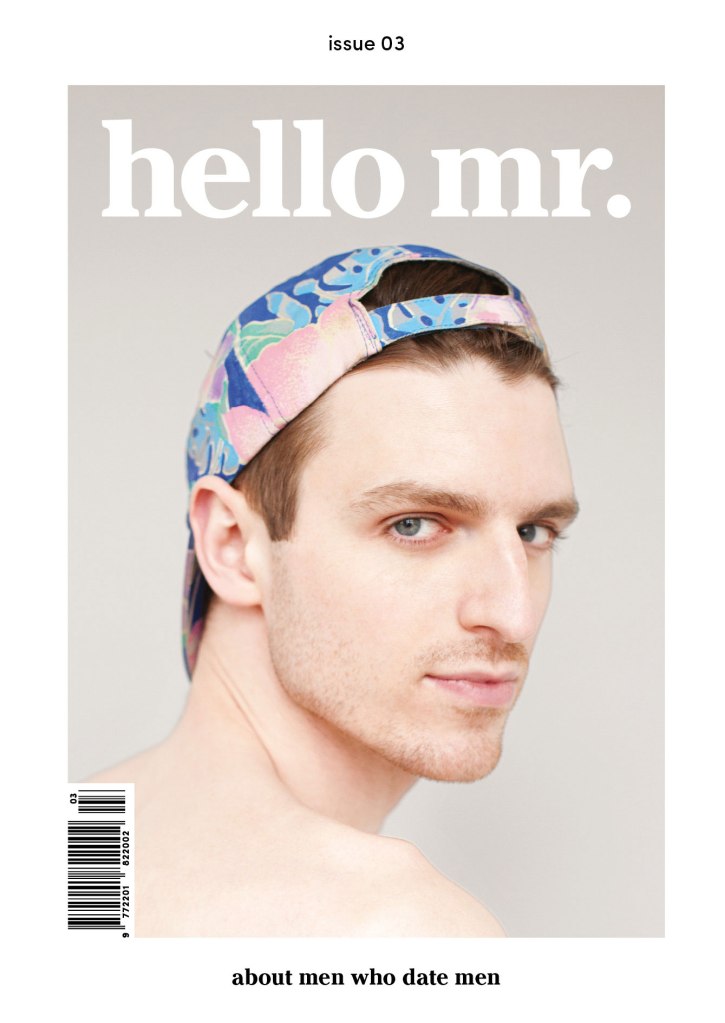
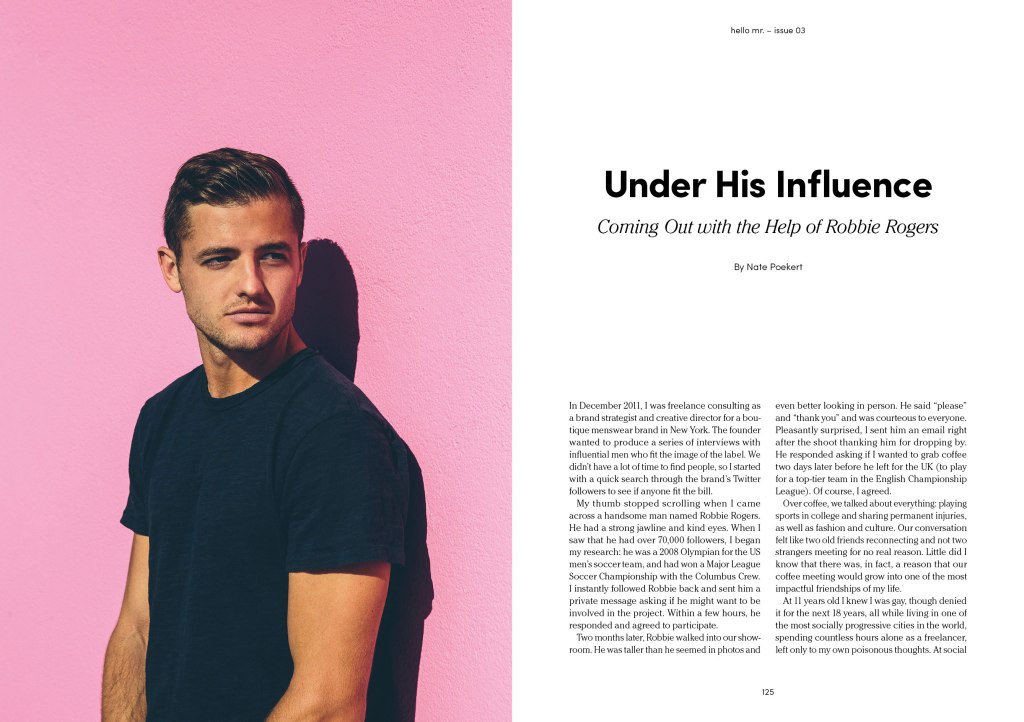
Hello Mr. is a bi-annual publication that launched in the spring of 2013 paving the way for a new generation of gay men. I spoke with its founder Ryan Fitzgibbon about the genesis of the project, how he executed his vision and how he continues to defy convention.
Tell us about the genesis of Hello Mr.
Hello Mr. started out as a blog that I created to gather a few of my friends in a common space. We could write about dating and what the gay dating sphere was like, talk freely. It was a very casual, safe space with somewhat infrequent posts, but soon enough I saw that there was something deeper to uncover in all this. It evolved into the concept for this magazine about a new generation of men. Those in middle existing media that paid no heed to the extremes—the chiseled go-go dancer in a rainbow Speedo, or the marriage equality activist standing with posters on the Capitol. These stereotypes are iconic of gay culture, but they’re extremes, and such, leave little room to showcase the reality of the everyday gay, which is what I was interested in.
You describe Hello Mr. as a community. Why did you choose print media as an expression of that community?
Print magazines have always been a love of mine. Independent publications are emerging in such a way so that now the Kinfolks and the Fantastic Mans of the publishing world are starting to surface in the mainstream, offered at big time bookstores and retailers. I think this new energy in the indie publishing world comes from the worth of thick, quality-printed, beautiful serial you can keep at your bedside or on your bookshelves. It’s a conversation piece and, similar to how the blog functioned, a common place. Because much of each issue comprises personal narratives and essays, it reads more like an anthology that acts as a reflection of the universal truths for many gay men around the world. The format, combined with the design details—the inclination to keep it on your coffee table rather than toss it in the recycling bin when you’re finished—establishes the worth of the object. Our readers take great pride in owning it, for lack of a less punny word.
How has autonomy informed the creative process for you?
I veered away from potential investors and advertisers early on in the process, and crowdfunded this fully, and then some. The first issue ran completely ad-free. Because the magazine came from the interest, motivation, and interest of those who were helping raise the fun, the engagement with the creation of this magazine meant so much more. If I’d gone another route, the response to the launch would have been totally different. I feel like readers (new or old) have been here since the beginning.
As a kind of solopreneur some of the toughest parts of this were in forming the style guide, building the brand, designing the website, assembling a contributors agreement, deciding how the book should be sectioned, etc. Because I was also scouting writers, photographers, and illustrators that I wanted to work with, it comes together somewhat organically. Not only do these pieces speak to each other, but they don’t have to be influenced by advertising, by the opinion of a major investor, or by the regionality of a publication. It’s universal and unbridled.
In an age where print media is in a state of flux and the current subscription model is to sell cheap, what are the challenges you faced launching your publication?
Starting any kind of new media or content-provider in this day and age comes with its challenges—the publishing world is saturated. But major magazines have dug themselves in a rut. They offered subscriptions cheaper and cheaper until you can get a year of periodicals for $5, which trains the consumer that these materials are cheap. So when you see a magazine that is $20, you might be confused at the pricing based on your prior knowledge of what other magazines cost. People might not purchase Hello Mr. because you wouldn’t spend $20 on Vanity Fair or Esquire. But this new breed of indie magazines is reclaiming the worth of print, and avoiding the tribulations of the electronic. Digital advertising revenue figures are nowhere near what everyone projected and eBook sales are steadily declining. Online engagement is undeniably important, but the trend of sales and readership (despite this massive shift to digital content) shows that people will always love holding something in their hands and putting something on their coffee table.
How do you mitigate merging art and commerce while maintaining the integrity of what you are doing?
As our magazine is starting to take on advertisers, I put a lot of thought into what products I’d want next to our content. I’m picky in the sense that I wouldn’t want a reader to flip through my magazine and feel isolated, or feel like the commerce that went with the content didn’t strike them in a positive way. It’s easy enough to take on every fashion brand and gay travel advertiser that comes your way, but it risks cheapening the quality readers are paying more for.
As a sort of weird parallel example, when Joanna Coles was put on as editor-in-chief of Cosmopolitan, one of her first motions was to cut off all relationships with the sex-toy advertisers that littered the back of the book. A year later, Cosmopolitan has won a National Magazine Award for the first time since its emergence in 1965. If you treat your brand with respect, your readers will respect it too.
What struck me in the first issue was how gay culture was normalized unlike the caricature presented in mass media. Was this a conscious decision?
Haha, yes. If anything it was the thing that set the whole mission in motion. More than anything, Hello Mr. is a platform to allow people to express their own experiences. We’re not necessarily trying to replace the current image of gay men, or condemning existing images of gay culture as necessarily a bad thing. It’s just that the gay population is divided into cultures and subcultures, with a few cultures that were being represented a lot and this whole middle culture that got zero to nothing. As I’ve said before, stereotypes are not going away—there’s nothing wrong with them existing and there’s truth in them. But what about the middle ground?
What have you learned about yourself during this process?
I’ve always been a designer and an art director, but I’d never ventured into editing professionally. In this new role, I’ve kind of surprised myself in finding out that this time around, being editor-in-chief is so much fun. I design the whole book, and it’s my aesthetic first-born. But when it comes to editing, I’ll sit and read submissions and laugh and cry and resist the urge to post stories immediately. I love promoting the work of my contributors, and I can’t believe I get to call that my job now.
Also, I’ve become better and better at delegating. I’ve always been the kind of person to let a lot rest on my shoulders until I’m at max capacity. After we packaged this last issue, I’d hired someone temporarily for brand partnerships, I am constantly giving work to our editorial assistant, enlisted multiple people to help me host events, reached out to writers and copyeditors, met up with over a dozen interns—and I’m starting to feel more balance because of it. From a glance, it might seem like a one-man show, but as always, I’ve learned that a community is the only thing that’s going to produce the high reaching results I’m aiming for.
How do you plan to evolve your brand?
I’m constantly getting feedback from my writers and readers. Having recently become one of the suggested users on Instagram, resulting in 33,000 new followers means we’re reaching a much larger audience now. It’s fun to see what people will react strongest to, and what they’ll neglect on social media. And trying to cultivate that online relationship is one way to produce the best possible experience for them. Creating the paper magazine means that I’m curating content that can be (and usually is) read from cover to cover. But my next venture will be in building the online community in the same vein as the original Hello Mr. blog. We have so many artists, writers, contributors, timely stories to draw from, but can’t fit into the print edition. It seems that the only logical way for our magazine to grow is to get more people participating in the conversation.
Nineties beauty Shirley Mallmann got her start in a small town in southern Brazil. It wasn’t long before she was treading the runways and gracing the pages of fashion bibles in campaigns for Alberta Ferretti, Christian Dior, Dolce & Gabbana, Emporio Armani and countless others. In addition she made an appearance in the Sports Illustrated Swimsuit Issue and the cover of multiple issues of Vogue.
Tell us about how you got started in modeling.
I come from a very small town in the south of Brazil. I was working in a shoe factory when a colleague of mine won a beauty contest and wanted to try modeling. We found a small modeling school in a nearby town and joined. The school had guest speakers one of which had a fashion column in south Brazil’s biggest newspaper. He asked if I wanted to do some photos for his column and an appearance on his TV show about fashion trends. I did it and between the two jobs earned more than a month’s pay in the factory so I quit my job and started modeling full-time.
How have you been able to achieve longevity in a field where so few make it?
That’s a hard question to answer. There’s no way of telling if you’ll make it or not. All you can do is try your best and see where it’ll take you. I’m a hard worker and I love what I do which is a big part of it. Genetics play an important part too. I’m very fortunate to be able to switch between high fashion and commercial work which adds to a broader appeal making my career longer and more versatile.
How have you found balance between modeling and family life?
It is a constant job coordinating the two. I have two boys in school so they have a set schedule while my husband, who’s a hairdresser, and I travel for work a lot. It’s a ping-pong game figuring out who will be home at what time of day, but babysitters, grandma and everybody else chips in a bit. When we’re all home together we try to make the most of it by doing special things with our kids.
What have you discovered about yourself through modeling?
When I was little my dream was to leave my parents farm and have my own apartment and my own car. The day I was set to move to New York for the first time I realized that all I wanted was to stay close to home. Even though we’re very lucky to travel to all these amazing places around the world I am the happiest at home, preferably near my family in Brazil. I also realized that I absolutely love fashion and my job, which I had no idea until I started working. That makes all the sacrifices worth it.
If you weren’t modeling what would you be doing?
I have always loved architecture and interior design. As a child I used to cut out apartment layouts from newspapers and pretend to be working on them. I probably would have done something along those lines.
What are your goals for the future?
My ultimate dream is to move my family back to Brazil. I would love to be able to instill the culture in my sons and have them enjoy the simple carefree life that I grew up with. I would also love to have my own children’s clothing line; it’s something I’m very passionate about.
What would people be surprised to learn about you?
Oh, I don’t know. I’m a very upbeat person and I try to make the best out of all situations. I love reading and sleeping. Here is a good one I guess…I’m scared of the outdoors at night. I don’t like to do much outside at night except maybe go to dinner or a party, but I prefer if they are indoors.
What does success mean to you?
To me it’s all the learning, to have made a difference in someone’s life, to be able to pass some of your knowledge to your kids. It also means having choices in life, whether to travel, spend time with your family or just take the day off if you feel like it.
Best known for casting, producing and creative consulting, Andrew Broz has an impressive roster that boasts clients from Vogue to Escada to Playboy. I caught up with Andrew to talk about his impressive background, Kate Moss and the future.
I found it incredibly fascinating how you got started in the business. Tell us about that.
I was fortunate at a very young age, especially coming from a small city in Pennsylvania, to have parents who supported my love for the entertainment industry. I started working as an actor and model when I was 10 and then decided to open a modeling agency AJB Model and Talent Management, at 14 out of my bedroom. I was a precocious kid and it seemed to make a lot of sense at the time. There wasn’t much of a market in Erie so I looked for clients in surrounding cities, scouted models and things just happened from there. When I was 16 I held a modeling convention in Erie. I flew about 20 agents in from Next, Ford, Company, etc., and placed models in different markets. After that, I received a lot of press, especially given I was a teenager, and was offered opportunities in New York to work as an agent at some fantastic agencies. I took advantage of the opportunities and relocated to New York when I was still 16. Soon after, still in my teens, I was an agent in the women’s division at Company Management and Ford Models handling top models and household names including talent such as Lizzy Jagger (Jerry and Mick’s daughter), James King, Frankie Rayder and An Oost.
I went to university in Pennsylvania so I’m aware how rural it can be. How did you scout models and were you taken seriously?
You have to remember this was the nineties prior to social media. I had saved a couple hundred dollars and I took an ad out in the classifieds for models. Was I taken seriously? That was a concern of mine, I mean I was 14. As you mentioned, I wasn’t exactly in a metropolitan city, either. Everyone is so aware of scams but I wasn’t running a scam and I wanted to make people money. I got a PO Box and worked up the courage to meet the people in person. So many people are excited to model in general and I was genuine. I worked really hard to obtain clients and bookings for them. I would call ad agencies and photographers and I contacted companies in Cleveland and Pittsburgh, which were two hours away, and book jobs for my models. I was really proactive about it.
You were obviously very focused and ambitious. Did you have an end goal in mind?
I was going with the flow but I knew I needed and wanted to go to New York to be an agent. At that age, I didn’t know specifics about where I needed to work. One of the agencies I had tremendous respect for was Michael Flutie and Company Management. I was very impressed with the creativity and imaging of that agency. I thought it was fantastic.
How do you define your role in the industry?
My role is constantly evolving, as is this industry. I have had the privilege of working as an agent for some of the top agencies and top models in the business. I have also had the opportunity to work for hundreds of large brands, top photographers, art directors, stylists and designers as a casting director and consultant. If I had to define my role, I would say vast and well-rounded.
A constant criticism leveled at the fashion industry is the lack of diversity whether that be age, weight or race and tokenism. What are your thoughts on this?
That’s a very layered question. I’ve worked both as an agent and also in the casting room. As I mentioned, I think this business is contantly evolving. Do I think it’s perfect with race or ethnicity? No, not at all. Do I think there have been major improvements? Absolutely. There are now cosmetic and advertising campaigns that are using models that weren’t used 10 years ago. That’s a fact however there’s still room for improvement.
I also think that there is room for diversity in age and weight. A lot of mothers and the public and accomplished models in this business are concerned about this. There is a significant age issue in this industry. It wasn’t like that as much before. So things change. I think it’s good that designers will book models from the nineties occasionally for their shows. On a personal level I’m more into models looking like women. I think that also allows younger girls to develop and grow into themselves physically and mentally. There doesn’t need to be such a rush.
Model watchers tend to be obsessed with the issue of “good casting/bad casting”. Do you subscribe to this idea?
Well, someone who is labeled a “model watcher” tends to be obsessed with most things in general. The concept of good vs. bad casting is completely relative. There is no “right” and there is no “wrong”. There are many cooks in that casting kitchen when a decision is made and a model is selected. It’s also important to remember that casting is not based on just a model’s looks alone. Many things often go into selecting talent. For example, many creative people never think about or have the knowledge of the actual sales of the line or company – or maybe have no access to those numbers. I have yet to meet anyone, including myself, that has the actual right to announce something as definitively good or bad casting.
How does it differ working in a more conservative market such as the US versus the UK or Europe?
Of course, there are the obvious differences, as you mentioned the term “conservative”. There are also different laws that must be adhered to in these different markets. Other than that, based on all of my experiences, I do not find my interactions that much different from various countries. Please remember that it is often just the same exact teams of photographers and stylists that work in all of these areas, generally.
Are there any models at the moment you think have potential longevity?
Absolutely. Many will say this industry is not what it was 10 or 20 years ago. I agree. That does not mean models can’t have longevity. There are many current models who are proving to have longevity while balancing a very diverse career, with both commercial and fashion clients. A lot of this credit should be given to their agents and managers as well.
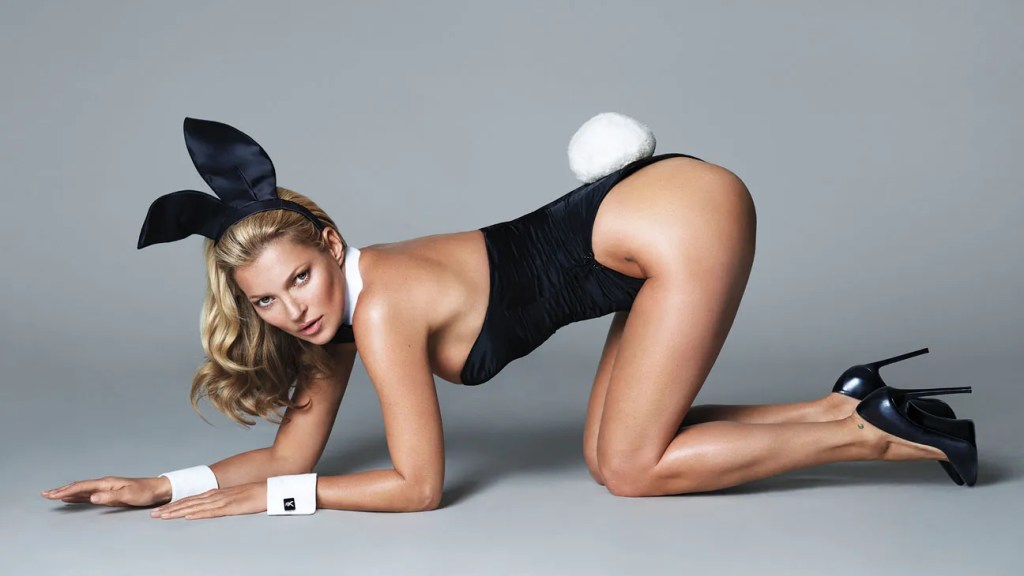
You were involved in getting Kate Moss on the cover of Playboy to celebrate her fortieth birthday. Tell us about that process.
That was a very exciting project to be a part of. The cover that Kate Moss appeared on was for the 60th anniversary of US Playboy. It happened, I believe, to fall around Kate’s birthday, but that was just a nice coincidence. Obviously, given that Playboy was celebrating their 60th year, they wanted an iconic cover. I worked very closely with IMG in order to secure this entire shoot and make certain Kate Moss appeared as the iconic talent that she is for this historical issue. Hugh Hefner always loved Kate and was delighted that this was able to happen. The process was not simple for me, as all of the individuals involved have quite busy schedules – however, it all came together in the end beautifully. Jen Ramey, who manages Kate, was very helpful with everything. Also, it was the first time that Mert and Marcus ever photographed for Playboy, Alex White acted as the stylist and Kate delivered amazing images as she always does. The issue sold in record numbers. I am very proud that I played a role in this and was thrilled upon seeing the images that were published.
What can we expect to see from you in the future?
I have been traveling a lot and, for the past few months, have been busy selling some property in North Carolina and looking after a family member who was quite ill. At the same time, I have been managing talent and casting shoots. However, I am returning to New York full-time in early June and you can expect to see a lot of wonderful things.